

From Homer’s heroes to Santorini’s sun-drenched caldera, the Greek spirit of welcome has never been just good service. It is a philosophy, a covenant, and a way of life.
A Word That Carries Centuries
The Greek language is one of the oldest living languages in the world, and few of its words carry as much weight as philoxenia. Composed of philos, meaning dear or beloved, and xenos, meaning stranger or guest, philoxenia translates most directly as love of the stranger. Yet translation, in this case, is inevitably reductive. To understand philoxenia, you must trace it back to its deepest roots, to a time when the arrival of a traveler at your door was not merely a social moment, but a sacred one.
In ancient Greece, hospitality was not optional. It was divinely sanctioned. Zeus himself, in his role as Zeus Xenios, was the protector of guests and strangers, the guardian deity of hospitality. To turn away a traveler, to treat a guest poorly, to fail in the duties of welcome was not simply impolite. It was an act of impiety, an offense against the gods. The consequences, as Homer so vividly illustrated in both the Iliad and the Odyssey, could be catastrophic.
In the Odyssey, Odysseus survives his long and perilous journey home not only through cunning and courage, but through the philoxenia extended to him by strangers across the ancient world. Each harbor, each palace, each simple hearth that welcomes him is an expression of this foundational Greek value. And when his own home in Ithaca is violated by the suitors who abuse his hospitality and dishonor the laws of the guest, the tragedy that follows is portrayed as nothing less than divine justice.
What Philoxenia Truly Means for Greece
Philoxenia Through the Ages: A Living Tradition
While ancient Greece provides philoxenia’s most dramatic expression, the concept did not fade with the fall of the classical world. Throughout the Byzantine era, monastic communities across Greece maintained elaborate traditions of hospitality. Monasteries served as guesthouses, infirmaries, and places of refuge, extending welcome to pilgrims, merchants, and travelers of every origin. The monk’s duty to welcome the stranger was considered as sacred as any act of prayer.
During centuries of Ottoman rule, when Greece existed as a network of tight-knit communities defending their identity, culture, and faith, philoxenia became an expression of collective resilience. To welcome a guest into your home was to declare that Greek civilization, with its values and warmth, endured. In villages across the Peloponnese, the Aegean islands, and the mountains of Epirus, the best food, the finest wine, and the most comfortable bed were always offered to the visitor, regardless of what the household had for itself.
This was not performance. It was identity. It remains so today.
Philoxenia in Modern Greece: From Tradition to Distinction
Contemporary Greece is, by any measure, one of the world’s most sought-after travel destinations. With more than 30 million visitors annually, the country has become synonymous with extraordinary natural beauty, ancient heritage, and, crucially, an atmosphere of warmth and welcome that visitors consistently describe as unlike anywhere else on earth.
Greeks will tell you that tourism has always existed here, because philoxenia has always existed here. Long before the rise of the modern hospitality industry, before boutique hotels and curated experiences became the vocabulary of luxury travel, Greek communities simply opened their doors. And while the world has since built an entire industry around the art of welcome, what sets Greece apart is that the instinct behind it has never been commercial at its core. It is cultural. It is personal. It is, in the truest sense of the word, emotional.
This distinction matters enormously for the discerning traveler. In a world where luxury hospitality has become increasingly standardized, where five-star service can feel scripted and impersonal, the Greek approach offers something genuinely different: the sense that your arrival matters, that you are not merely a guest but someone whose presence is considered a gift.
What Philoxenia Truly Means for Greece
Santorini: Where Philoxenia Reaches Its Highest Expression
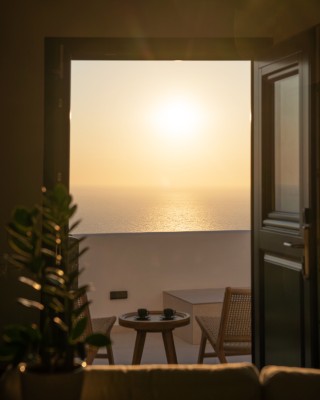
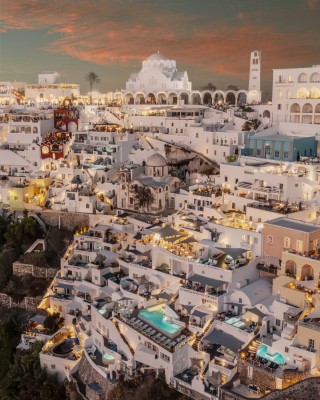
Of all the places in Greece where philoxenia takes on a particular intensity, few rival Santorini. Perched on the caldera of an ancient volcano, draped in whitewashed architecture that glows gold in the late afternoon sun, this island has long held a singular place in the imagination of luxury travelers worldwide. But what brings people back to Santorini, year after year, is rarely just the famous sunset or the Aegean panorama. It is how the island makes them feel.
Santorini’s hospitality culture is deeply layered. The island’s small size and its intimate, village-scale communities mean that service here retains a human dimension that larger destinations often lose. The local families who have built suites and hotels on the caldera cliffs are not distant corporate entities: they are your neighbors for the duration of your stay. They know the best wine producer in Pyrgos. They know the secluded cove where the water is clearest in July. They remember your name.
This is the Santorini that the finest hospitality experiences are designed to deliver, one where the island’s natural grandeur is matched by an equally elevated standard of personal care.
Aestian: Philoxenia as a Living Practice
At the heart of Santorini’s premium hospitality landscape sits Aestian, a collection of hotels, suites, and restaurants that has made philoxenia not just a value but an operational philosophy. Born from the soul of the island, Aestian exists to celebrate place, heritage, and the refined art of welcome in its most authentic form.
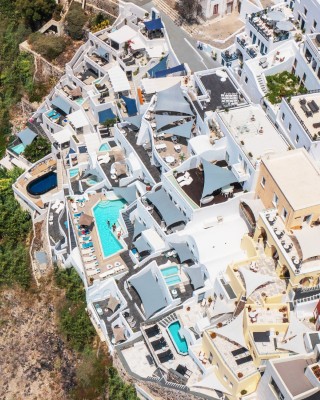
The Aestian portfolio spans some of Santorini’s most celebrated properties. Athina Luxury Suites commands the iconic caldera of Fira, where breathtaking views unfold from every private balcony. Venus Sunrise Suites and Villas offers a tranquil retreat in the traditional village of Vourvoulos, where spacious suites and private pools create the ideal sanctuary for couples and families seeking genuine seclusion. Eteoro Suites perches above the dramatic cliffs of Imerovigli, delivering panoramic caldera views alongside the ultimate in relaxed elegance. Sienna Eco Resort, nestled by the shores of Exo Gialos, brings a quietly considered approach to sustainable luxury, where eco-conscious design meets the serenity of Santorini’s lesser-explored coastline.
Aestian’s dining experiences carry the same philosophy. Rizes Gastro Taverna is a love letter to the Greek table, a farm-to-table destination that celebrates the island’s culinary heritage through seasonal ingredients, ancestral recipes, and flavors rooted in the volcanic soil of Santorini. Esperisma Bar Restaurant perches on the caldera cliffs at Fira, pairing inspired Mediterranean cuisine with the signature Santorini sunset. And Mylos Champagne Bar Restaurant in Firostefani brings decades of gastronomic history to a setting of unparalleled natural drama, where refined cuisine, thoughtful wine selections, and caldera views converge in an experience that is, simply, unforgettable.
Across each of these spaces, the thread of philoxenia runs constant. The Aestian team does not merely execute hospitality to a standard. They extend it as the ancient Greeks intended: as a personal, heartfelt, and deeply meaningful act of welcome.
What Philoxenia Truly Means for Greece
The Timeless Covenant Between Host and Guest
There is something profound about experiencing philoxenia as a contemporary luxury traveler. In the finest hotels of Santorini, when a team member remembers not only your room preference but your anniversary, when a chef creates a dish around an allergy you mentioned in passing, when a concierge stays an extra hour to ensure your private sailing arrangement is perfect, what you are experiencing is not simply excellent service.
You are experiencing a covenant that is three thousand years old.
Philoxenia, at its deepest level, is the recognition that every traveler carries within them something worthy of honor. That the act of crossing a threshold, of arriving somewhere new and unfamiliar, is a moment of vulnerability that deserves to be met with generosity. In ancient Greece, Zeus was watching. In modern Santorini, the finest hosts understand that their greatest responsibility is to the human being who has entrusted them with their time, their memory, and their experience of wonder.
This is what Greece has always understood, and what Aestian continues to practice. Not hospitality as a transaction, but welcome as a form of love.
Experience Philoxenia at Its Finest
Santorini is waiting. And at Aestian, so is a team of people who have made it their life’s work to welcome you in the oldest and most beautiful tradition Greece has ever known.
Whether you are planning a romantic escape, a family retreat, or a journey of genuine discovery across the caldera, Aestian invites you to arrive not as a tourist, but as an honored guest.
Discover the Full Aestian Experience

Panagiotis Inglesis is the co-owner and General manager of Athina Luxury Suites, along with his wife Mrs.Artemis Argyrou. Together they had a vision to create one of the best boutique hotels in Santorini and today they continue their vision…Athina Luxury Suites is considered one of the top hotels on the island.